

Your Essential Guide to Better Apparel & Merch
Whether you're launching a fashion label, printing uniforms for your team, creating merchandise for your band or ordering branded apparel for your business, getting the right result starts before the garments reach the printing press.We've put together this guide to help you understand the printing process, choose the right garments and print method, prepare your artwork and avoid some of the common mistakes we see.
Not sure what you need? That's completely fine. Tell us what you're trying to achieve and we'll recommend the best approach.



01 — BEFORE YOU ORDER
How Screen Printing Works
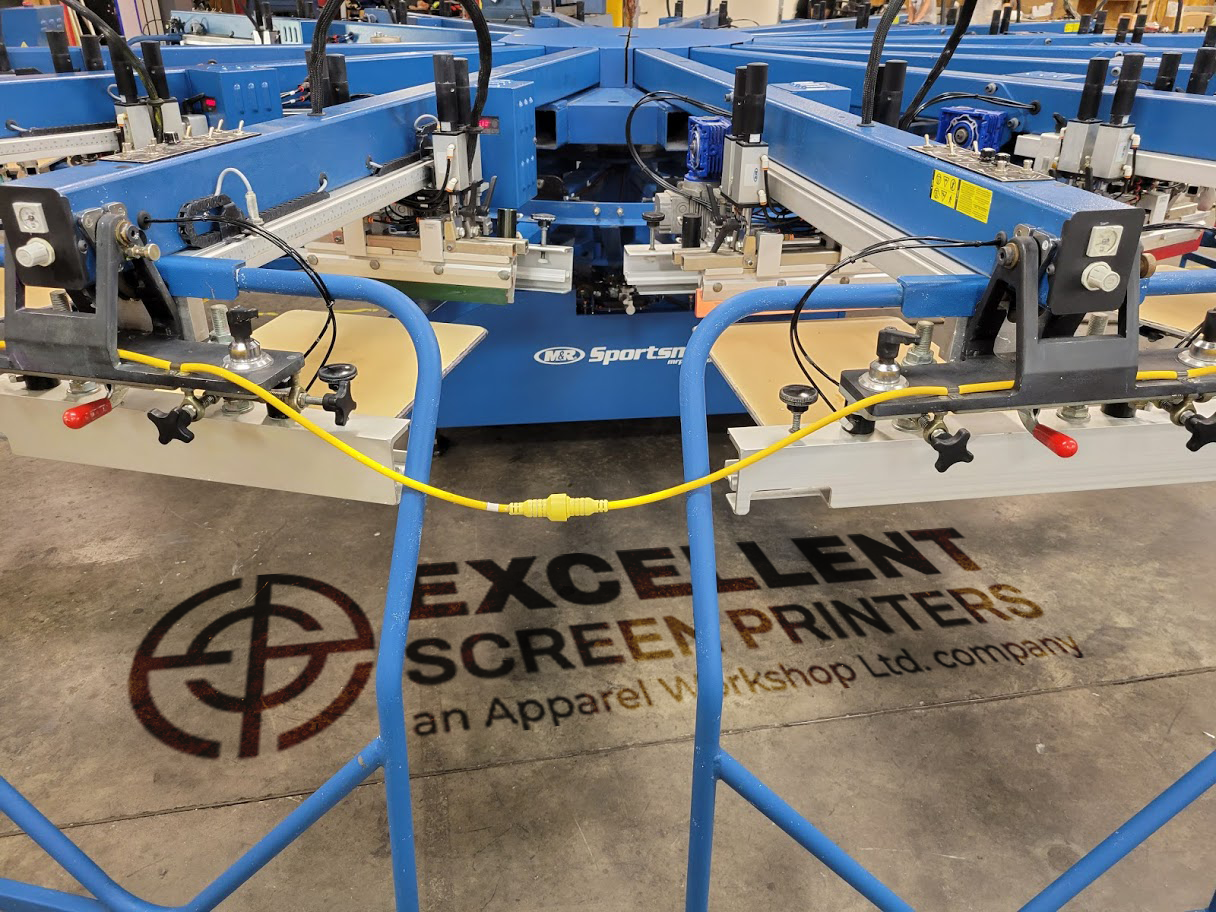
Screen printing is a production process where ink is pushed through a specially prepared screen onto the garment.
Each colour in your artwork requires its own screen, which is why the number of colours, print locations and quantity of garments all affect the cost.
Screen printing is particularly cost-effective when producing larger quantities because the initial setup costs are spread across more garments.
Screen printing is ideal for:
Fashion brands
Workwear and team apparel
Events and merchandise
Bands and artists
Corporate apparel
Promotional clothing
Repeat orders
Medium to large production runs
If you're only after a few garments, a transfer-based process such as DTF or Supacolour may be a more economical option.
How Many Garments Should I Order?
Our standard commercial screen printing minimum is 12 garments per print colour.
For example, if your artwork has:
1 colour = 12 garments minimum
2 colours = 24 garments
3 colours = 36 garments
4 colours = 48 garments
These are guidelines to help explain how our production pricing works. If you have a smaller quantity, we can still recommend an alternative printing method that may be more suitable.
Need fewer than 12?
For one-off garments and very small orders, we have Apparel Workshop, our online-only store created specifically for smaller orders that don't require the commercial durability and production process of screen printing.
Order online at www.apparelworkshop.co.nz and choose from DTF and other transfer options without the minimum quantities required for commercial screen printing.
Perfect for: one-off shirts, small runs, samples, personal projects and quick orders.
02 — CHOOSING YOUR PRINT METHOD
Which Printing Method Is Right For Me?
There isn't one printing method that's best for every job. The right choice depends on your quantity, artwork, garment, colours, desired finish and budget.
Screen Printing
Best for: medium to large quantities and repeat production.
Screen printing offers excellent durability, strong colour and a wide range of finishes.
Embroidery
Best for: polos, caps, workwear, corporate clothing and premium branding.
Embroidery creates a durable, professional finish and is particularly suited to logos and simpler artwork.
Discharge Printing
Best for: suitable cotton garments where a soft, vintage or fashion-focused finish is required.
Discharge ink reacts with the dye in the garment to remove the garment colour while replacing it with the print colour.
It can produce an exceptionally soft print, but it isn't suitable for every garment or colour.
Puff Printing
Best for: bold logos, streetwear and designs where you want a raised 3D effect.
Puff ink expands under heat to create a raised print.
High Density Printing
Best for: premium graphics where you want a raised, dimensional finish.
High density printing creates a sharp, tactile print with significant surface height.
Supacolour Transfers
Best for: detailed, full-colour graphics and applications where a transfer finish is preferred.
Supacolour is particularly useful for smaller production runs and certain specialty applications.
DTF Transfers
Best for: one-offs, small quantities and complex full-colour artwork.
DTF allows us to produce detailed artwork without the screen setup required for traditional screen printing.
03 — CHOOSING YOUR GARMENT
The Garment Makes a Difference
The blank garment you choose can have a major effect on the finished print.
Things such as fabric composition, weight, texture, colour and construction can all influence how ink behaves on the garment.
When choosing a garment, consider:
Cotton or polyester
Fabric weight
Fabric construction
Garment colour
Surface texture
Stretch
Garment dye
Seams and construction
Intended use
Desired print finish
A garment that looks great on a website isn't necessarily the best garment for the printing method you've chosen.
We Can Supply Your Garments
You don't need to source and supply your own garments. We can supply a wide range of quality blank garments at competitive wholesale prices, giving you the convenience of having your garments and printing handled by one supplier.
We can also recommend garments based on your artwork, budget, fit and desired print finish.
If you're unsure which garment is right for your project, ask us before ordering.
04 — PRINT PLACEMENT & SIZE
Where Can We Print?
Common print locations include:
Left chest
Right chest
Centre chest
Full front
Upper back
Full back
Sleeves
Pocket area
Lower body
The ideal print size depends on the garment size, print location and artwork.
Our equipment allows print sizes of up to approximately 500mm × 500mm, although the practical print area depends on the garment.
Oversized Printing
Oversized prints can create a great fashion look, but the size of the print needs to be considered alongside the garment size.
Our oversized printing platens are physically quite large. On smaller adult garments, particularly an Adult Small, these are not wide enough to properly stretch the garment over the platen. This can make it difficult or impossible to position and print a true oversized design correctly.
We can recommend the most appropriate print size and setup for your garment size range to ensure the best possible result.
Print Sizes Across Different Garments
For most adult size ranges, we can normally set up one screen and one print size that works across approximately Women's XS through to Men's 3XL. This keeps production efficient and avoids unnecessary additional setup costs.
Children's garments are different. Because they are significantly smaller, the same print size may not be suitable across the entire size range. In some cases, adding kids' sizes may require additional screen sizes and separate production setups.
This is particularly important when ordering a mixed range of adult and children's garments, as different print sizes can increase setup and production costs.
We'll always review your garment size range and recommend the most practical print sizes and setup to achieve a consistent result while keeping production as efficient as possible.
Can You Print Over Seams?
Printing over seams or around the side of a garment can be difficult because the printing surface is no longer flat.
This can result in:
Uneven ink coverage
Gaps in the print
Distortion
Ink build-up
Inconsistent print quality
If your design needs to wrap around a garment, we'll recommend the most reliable way to achieve the effect.
05 — ARTWORK
What Artwork Do We Need?
For the best possible result, we prefer artwork supplied as a vector file.
Preferred file formats:
Adobe Illustrator (.AI)
PDF
EPS
SVG
High-resolution PNG files can also be suitable for some artwork.
Vector artwork is ideal because:
It can be scaled without losing quality.
Lines remain sharp.
Colours can be separated accurately.
Small details can be checked and adjusted.
It gives our artwork team greater control during production.
If you don't have suitable artwork, that's okay.
Our artwork team can help prepare your design for production.
What Makes Good Screen-Printing Artwork?
Screen printing works particularly well with:
Bold shapes
Solid colours
Strong contrast
Clean line work
Simple colour palettes
Vector artwork
Artwork can become more challenging when it contains:
Extremely fine lines
Very small text
Complex gradients
Photographic imagery
Very detailed effects
Artwork crossing seams
That doesn't necessarily mean we can't print it.
It simply means we'll need to determine the best production method.
06 — COLOUR MATCHING
How Do We Match Colours?
For accurate colour matching, we use Pantone Solid Coated colours.
If you have a specific brand colour, supplying the Pantone reference gives us the best starting point for matching your print.
Important things to know:
Your computer screen isn't a reliable representation of the final ink colour.
RGB, HEX and CMYK colours are digital colour values and don't directly translate into a screen-printing ink colour.
The colour of the garment can also affect how the finished ink appears.
For the most accurate colour reference, always provide the appropriate Pantone colour.
How Closely Can We Match a Pantone Colour?
Pantone colours give us a standard colour reference, and we use Pantone Solid Coated for screen printing.
We can usually get very close to your chosen Pantone colour, but an exact match on fabric cannot always be guaranteed.
The final colour can be affected by:
The colour of the garment
The type and opacity of the ink
Whether a white underbase is used
The fabric itself
On white or light garments
These generally give us the closest match to the selected Pantone colour.
On dark or coloured garments
The garment colour can affect how the ink looks. A white underbase can help the colour stay bright and closer to the Pantone reference, but the result can still vary slightly.
Pantone gives us the target colour, but the finished print may vary slightly from the Pantone swatch.
If an exact brand colour is particularly important, let us know when requesting your quote so we can advise on the best approach.
07 — THE ORDER PROCESS
What Happens After I Request a Quote?
1. Request Your Quote
Send us your garment requirements, quantities, artwork and print details.
2. We Prepare Your Quote
We'll review your requirements and recommend the most suitable production method.
3. Approve Your Quote
Once your quote is approved, we can move your job into production planning.
4. Artwork & Print Specification
Our artwork team prepares the artwork and print specification required for production.
5. Approve Your Proof
You'll have the opportunity to check the artwork, placement and colours before production.
6. Production
Once everything is approved, your garments move into production.
7. Quality Check
Completed garments are checked before being packed.
8. Collection or Delivery
Your finished order is prepared for collection or dispatched to you.
08 — PROOFS & SAMPLES
What Is a Print Proof?
A digital print proof allows you to check:
Artwork
Print location
Approximate print size
Colours
Garment
Overall layout
The proof is an important part of the approval process because it gives you the opportunity to identify any changes before production begins.
Can I Get a Screen-Printed Sample?
Screen printing involves significant setup, including films, screens, inks and press setup. For this reason, producing a single screen-printed sample isn't normally economical.
However, if colour accuracy or the final print appearance is particularly important, we can offer a pre-production sample before proceeding with the full production run. This allows you to check the print and colours on the actual garment before we produce the complete order.
Pre-production samples are subject to an additional setup and sample charge.
For small quantities or sample garments where a screen-printed sample isn't required, we can often recommend a transfer-based solution such as DTF.
09 — REPEAT ORDERS
Ordering the Same Design Again?
Repeat orders are straightforward.
Once your artwork and production specifications have been established, we can use those details for future orders.
This makes repeat production quicker and helps maintain consistency between orders.
Our current repeat-order screen policy:
Repeat orders within 6 months: no screen setup charge
Repeat orders after 6 months: a reduced setup fee may apply
If your artwork or print specification changes, additional setup may be required.
10 — LOOKING AFTER YOUR PRINTED GARMENTS
How Should I Wash My Printed Garments?
For the longest possible print life:
Follow the garment's care instructions.
Wash garments inside out where practical.
Use a cold wash.
Avoid harsh chemicals and bleach.
Never iron directly over the printed area.
Don't use excessive heat when drying.
Good garment care helps protect both the fabric and the print.
11 — QUALITY & EXPERIENCE
Why Print With ESP?
We've been working in the apparel and printing industry for 30 years.
Our experience covers everything from fashion labels and start-up brands to tradie crews, bands and major technology companies.
We combine experienced artwork and production teams with modern screen-printing equipment to produce consistent, high-quality results.
Our capabilities include:
Commercial screen printing
Embroidery
DTF transfers
Supacolour transfers
Discharge printing
Puff printing
High-density printing
Custom woven labels
Printed labels
Silicone labels
Custom badges
Swing tags
We're not just here to print what you send us.
If there's a better way to produce your job, we'll tell you.
12 — BEFORE YOU REQUEST A QUOTE
Have These Details Ready
You don't need to know everything before contacting us, but having the following information will help us quote your job accurately:
Garment style
Garment colour
Quantity
Size breakdown
Print locations
Artwork
Number of print colours
Pantone colours, if applicable
Required date
Any special print requirements
Not sure?
Don't worry.
Send us what you have and tell us what you're trying to achieve.
We'll help work out the best garment, print method and production approach for your job.
HAVE A PROJECT IN MIND?
Whether you're producing 12 shirts or a large commercial run, we'd love to help.
Request a Quote
Not sure which printing method is right for you?
Talk to our team
We're happy to recommend the best option based on your artwork, garments, quantity and budget.